In the hospitality industry, the bathroom is much more than a functional space: it embodies a true customer satisfaction asset. Often perceived as a direct reflection of the establishment's standing, it influences the overall experience, the perception of cleanliness, and even the likelihood of return visits. Renovating a hotel bathroom requires finding the right balance between design, durability, and compliance with standards.
At Grosfillex Expert, we assist professionals in transforming spaces by offering wall covering solutions that combine design, technical performance, and ease of installation. In this article, we reveal everything you need to know before redesigning a hotel bathroom.

Current trends in bathroom design
Today, travelers are looking for modern, bright, and uncluttered bathrooms. Walk-in showers are among the most popular choices: their level access enhances comfort, improves safety, and offers a highly prized visual continuity in high-end establishments. They also save space, a major advantage in sometimes compact rooms, while offering better accessibility, especially for people with reduced mobility or guests needing more stability.

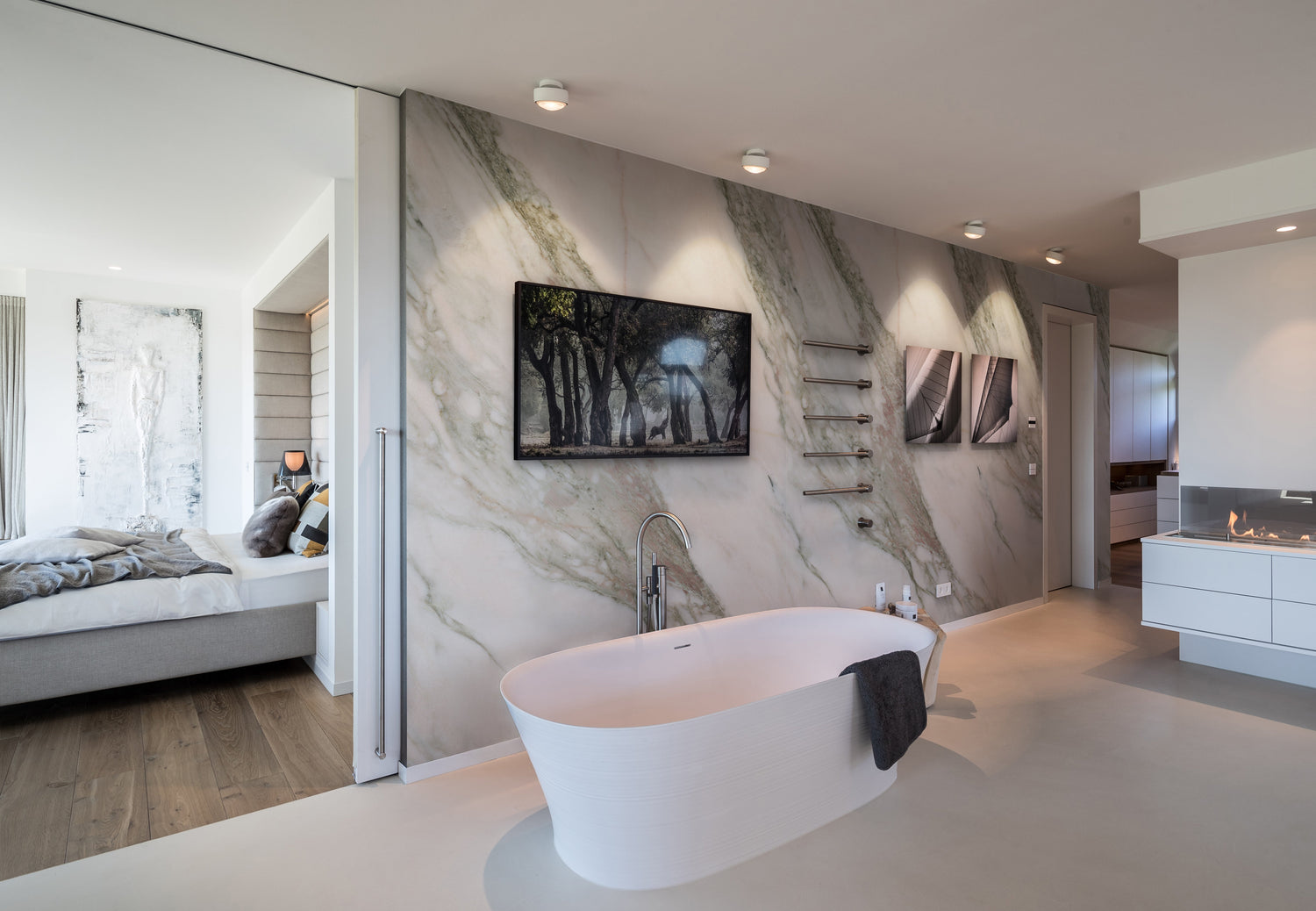
Noble materials (stone, wood, marble) are gaining popularity, but their technical and maintenance constraints can hinder their adoption in hotels. This is why many establishments are turning to composite materials capable of mimicking the appearance of marble or concrete while maintaining increased resistance to humidity, shocks, and temperature variations. Grosfillex wall coverings precisely meet this expectation: they reproduce natural textures while facilitating daily maintenance.
The trend is also towards water saving. Thermostatic mixers, optimized flow showers, and water recovery systems are becoming standard. These solutions reconcile user comfort with reduced operating costs and environmental commitment, a criterion increasingly observed by travelers and review platforms.
Standards and technical constraints to respect
Renovation goes hand in hand with compliance, especially in wet areas such as bathrooms where the risks of slipperiness, mold, or degradation are high. Hotels must ensure that their bathrooms comply with European standards for safety, hygiene, and accessibility.
One of the first points concerns moisture resistance: materials used for walls, floors, and ceilings must prevent infiltration and limit condensation. Waterproof composite panels, often favored in renovation, offer a reliable and durable solution, especially when installed as a replacement for traditional tiling.
Accessibility for People with Reduced Mobility (PRM) must also be taken into account, especially for establishments subject to ERP regulations. This implies minimum dimensions for the shower, grab bars, but also a reflection on the general circulation in the room.
Finally, constraints related to daily operation (maintenance, resistance to professional cleaning products, longevity of surfaces) must guide choices. Hotels look for non-slip floors, easy-to-disinfect materials, and surfaces capable of withstanding several cycles of use per day. Renovation cannot afford approximation: every detail must serve durability.
Optimizing space and design adapted to travelers
Space is often limited in hotel bathrooms. The objective is therefore twofold: optimize every centimeter and create an impression of volume without sacrificing comfort. Suspended solutions (washbasin, toilet, storage) free up floor space and provide a sense of openness, while facilitating maintenance.
The choice of tones and textures plays a major role. Light colors, satin finishes, and imitation stone or concrete coverings create a calming and contemporary atmosphere. Resin or composite materials achieve these effects while maintaining ultimate resistance.
Travelers also seek practical design: integrated storage, anti-fog mirrors, functional lighting, and water points designed for two people when the room is double. The goal is to offer an experience as pleasant as it is intuitive.
In establishments targeting an international clientele, the universality of design is essential. Easy-to-understand water controls and spacious showers are all details that contribute to overall appreciation. Here again, Grosfillex Expert solutions allow for the creation of a coherent, modern, and durable decor, without increasing maintenance constraints.
Solutions for renovation with wall covering
Wall renovation is one of the most effective levers for quickly transforming a bathroom, without undertaking heavy work. Composite panel wall coverings represent an ideal alternative to tiling, which is often longer and more expensive to install.
Grosfillex Expert coverings offer several advantages:
· Quick installation, even directly over the old substrate, which reduces room downtime.
· Integrated waterproofing, essential in environments subject to permanent humidity.
· Variety of styles, with marble, concrete, natural stone effects, or modern textures.
· Simplified maintenance, thanks to non-porous surfaces resistant to cleaning products.
These panels allow an entire bathroom to be renovated in just a few hours, limiting disruption to hotel activity. They also guarantee a consistent finish quality, without joints, which reduces the risk of mold and degradation.
For establishments looking to modernize their image, wall covering represents a strategic investment: it immediately improves aesthetics, increases the sensation of cleanliness, and reinforces the perception of quality.
Renovating a hotel bathroom requires a global approach where design, practicality, and compliance meet. By choosing durable materials, optimizing space, and adopting modern wall covering solutions, establishments can transform their bathrooms into true loyalty assets.
With Grosfillex Expert, hotels benefit from solutions designed for performance, aesthetics, and durability, allowing them to offer their guests an experience as comfortable as it is unforgettable.